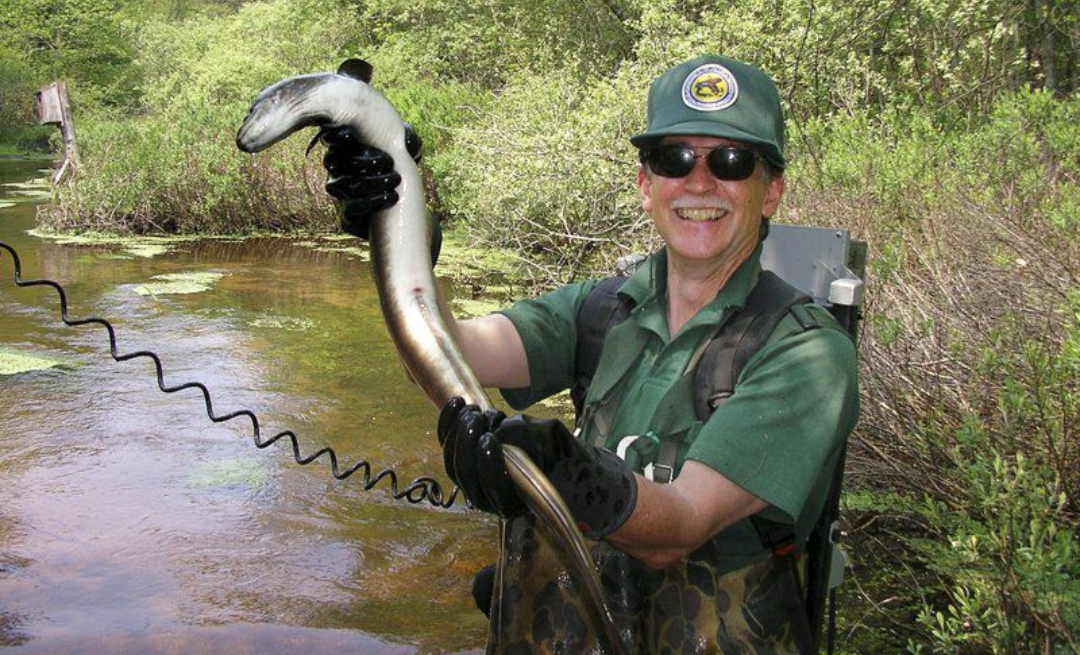
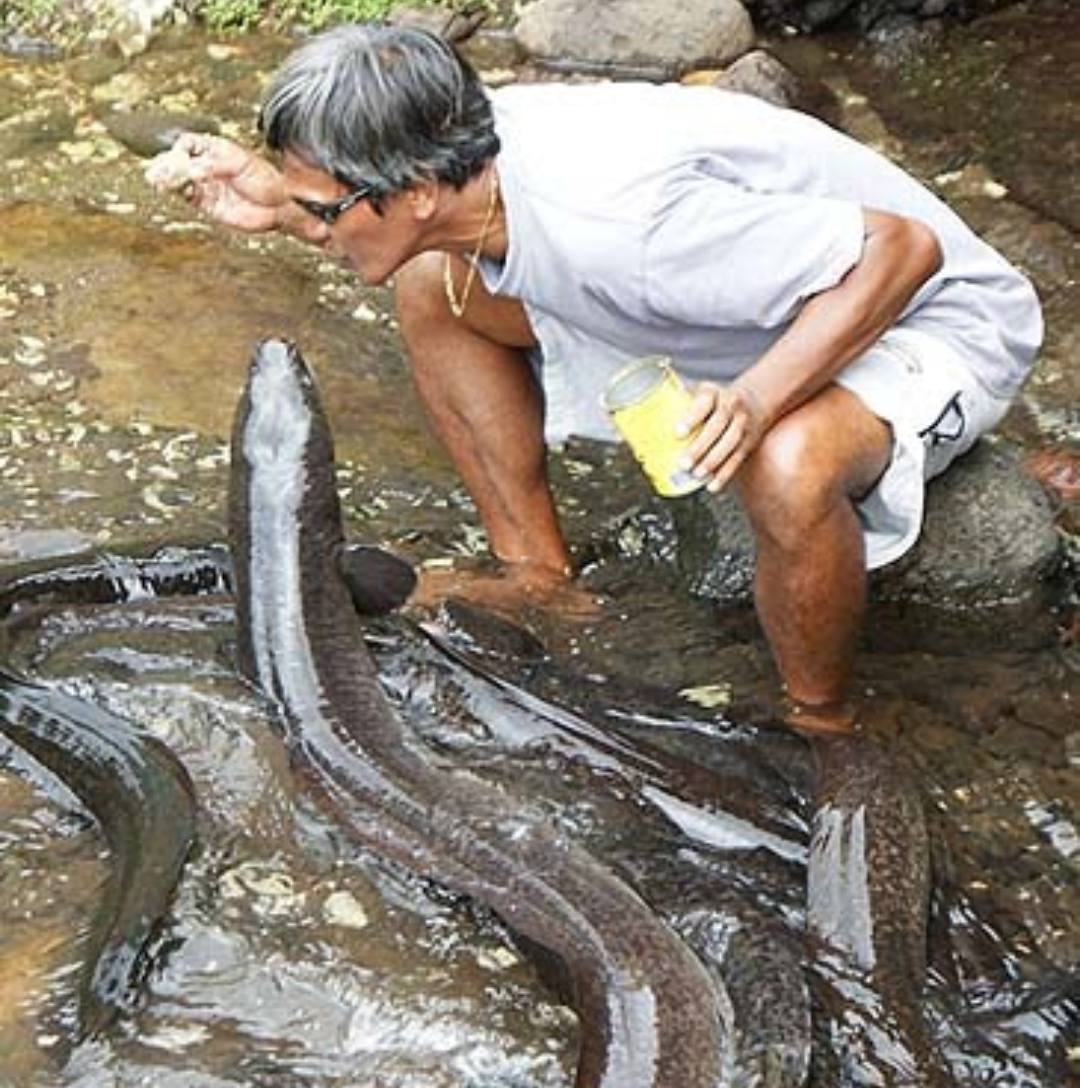
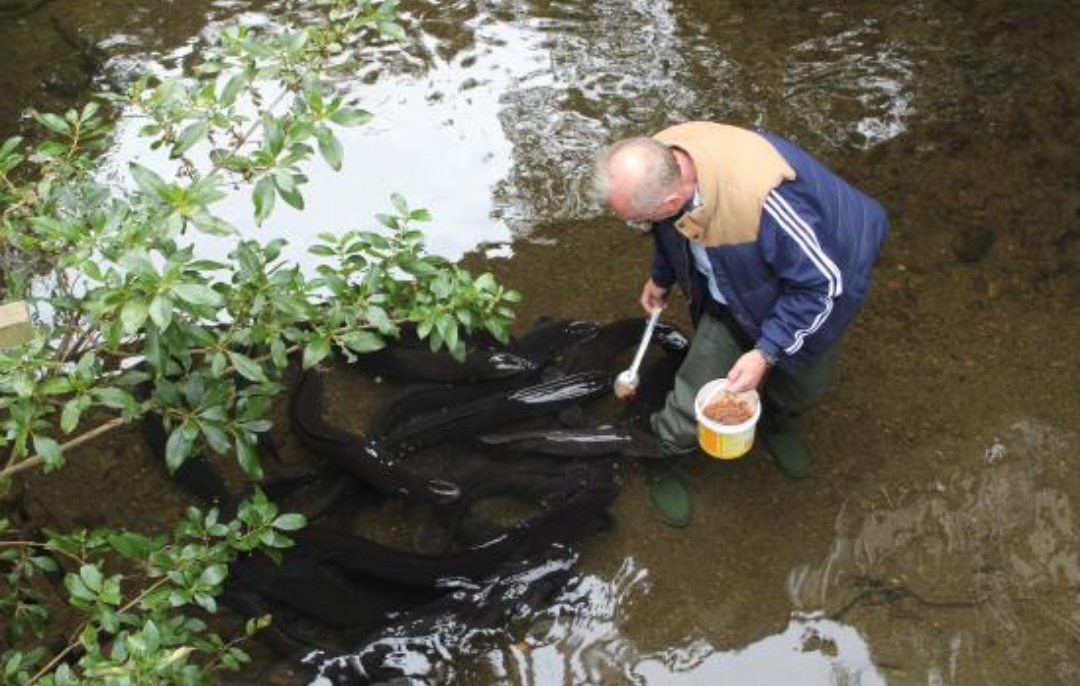
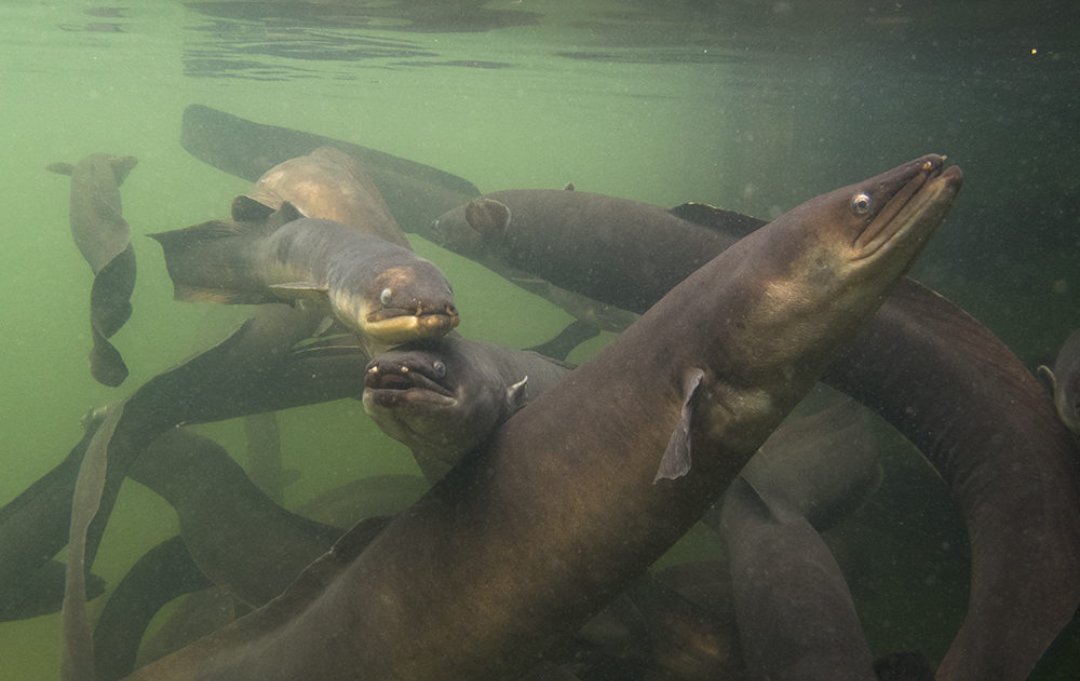
these wiggly fellas are Anguilla dieffenbachii, orNew Zealandlongfin eels. the ones in local rivers and preserves are known for being gentle, food-driven little weenies that beg tourists for food.
especially hungry wild specimens have been reported to attack humans and animals by swarming them and ripping off their flesh, but these ones are harmless!
@eelpatrickharris how can you tell them from other freshwater eels, I’m curious? I was looking around, and it seemed like while some are pretty different (some have spots, etc), there were a bunch that looked basically like this. I was thinking American eels, since OPs profile says Texas, but I certainly couldn’t tell for sure.
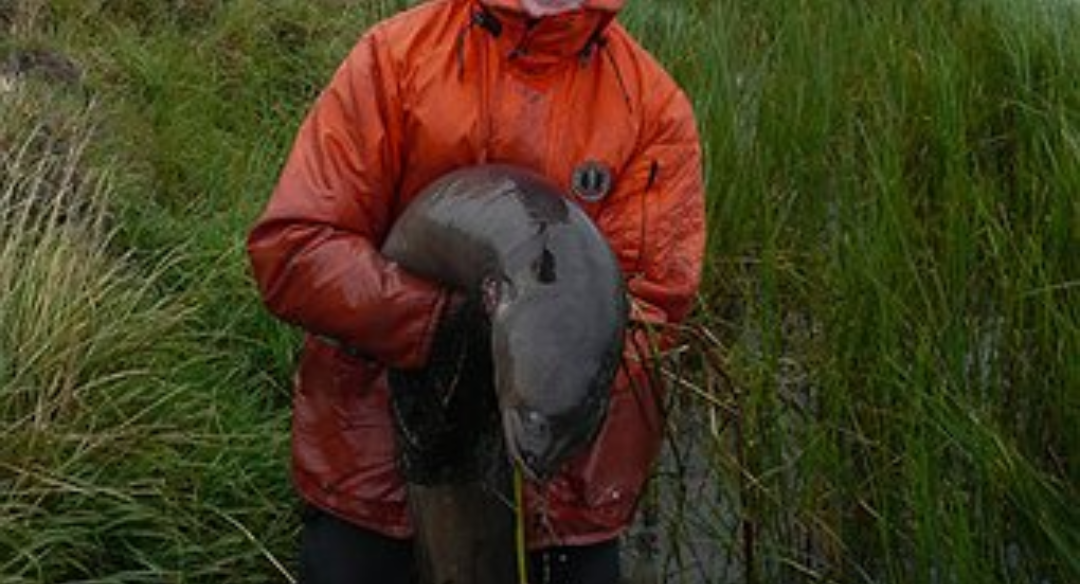
the size, behavior, and thickness! you see, NZ longfins are known for travelling in herds, and they are big boys. while the majority of anguilla eels grow to 3.3 feet on average—a. rostrata, a. anguilla, a. japonica—longfins can and will grow to 6 feet and over. there have been reports of them growing to 10 feet, but due to overfishing, any specimens like that are long gone.
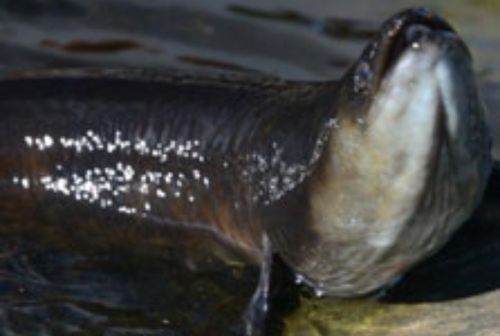
also, girth. top is a fully grown american eel (4 feet is their absolute maximum, 3 is average), and below is a new zealand longfin who has a few feet to go.
when it comes to mannerisms, you’ll almost never see american eels in groups outside of mating season, when they all migrate to the sea. they’re highly aggressive, distrustful of humans, and bitey. longfins, on the other hand, stick together and act like big water dogs.
it’s a common thing in NZ to have “pet” eels. people will feed scraps of meat to the ones in their local streams, and they’ll start wiggling excitedly when they see you! those eels in the video are just getting really pumped because they think someone has treats. (even though it’s bread, which is bad for them.)
they’re not as scary as they seem. NZ longfin eels just want to be your friend!
(note: this only applies to ones that live in preserves and rivers near civilization. eels from huge lakes and remote areas are generally starving and i don’t recommend trying to be their friend.)
Using unwholesome language to keep your show wholesome
Awwwwwwww
As well as swearing, they also use brand names,
This must be the definition of chaotic good honestly
Honestly it would probably also help me stop crying if there was a lady standing next to me shouting “Nike! Adidas! Tastykake! Gucci! Google! Pringles! Fuck, I’m blanking shit shit shit fuck shit just keep swearing shit shit COMCAST”
me: *crying over croisants* two british ladies: *chanting* CUNT CUNT CUNT CUNT CUNT
It’s okay to have fictional characters do problematic stuff. Really, it is. Fictional characters are there to tell a story; not to be perfect paragons of virtue.
“Yeah!” some people will say. “It’s fine as long as you show that it’s problematic!”
And I’ll say: No. You don’t need to always do that either. We can’t expect writers to point out every moral misstep a character makes.
It’s okay to have characters do something problematic, and it’s okay to assume that the readers can see why it’s problematic on their own.
“If autism isn’t caused by environmental factors and is natural why didn’t we ever see it in the past?”
We did, except it wasn’t called autism it was called “Little Jonathan is a r*tarded halfwit who bangs his head on things and can’t speak so we’re taking him into the middle of the cold dark forest and leaving him there to die.”
Or “little Jonathan doesn’t talk but does a good job herding the sheep, contributes to the community in his own way, and is, all around, a decent guy.” That happened a lot, too, especially before the 19th century.
Or, backing up FURTHER
and lots of people think this very likely,
“Oh little Sionnat has obviously been taken by the fairies and they’ve left us a Changeling Child who knows too much, and asks strange questions, and uses words she shouldn’t know, and watches everything with her big dark eyes, clearly a Fairy Child and not a Human Like Us.”
The Myth of the Changeling child, a human baby apparently replaced at a young age by a toddler who “suddenly” acts “strange and fey” is an almost textbook depiction of autistic children.
To this day, “autism warrior mommies” talk about autism “stealing” their “sweet normal child” and have this idea of “getting their real baby back” which (in the face of modern science) indicates how the human psyche actually does deal with finding out their kid acts unlike what they expected.
Given this evidence, and how common we now know autism actually is, the Changeling myth is almost definitely the result of people’s confusion at the development of autistic children.
Weirdly enough, that legend is now comforting to me.
I think it’s worth noting that many like me, who are diagnosed with ASD now, would probably have been seen as just a bit odd in centuries past. I’m only a little bit autistic; I can pass for neurotypical for short periods if I work really hard at it. I have a lack of talent in social situations, and I’m prone to sensory overload or you might notice me stimming.
But here’s the thing: life is louder, brighter and more intense and confusing than it has ever been. I live on the edge of London and I rarely go into the centre of town because it’s too overwhelming. If I went back in time and lived on a farm somewhere, would anyone even notice there was anything odd about me? No police sirens, no crowded streets that go on for miles and miles, no flickery electric lights. Working on a farm has a clear routine. I’d be a badass at spinning cloth or churning butter because I find endless repetition soothing rather than boring.
I’m not trying to romanticise the past because I know it was hard, dirty work with a constant risk of premature death. I don’t actually want to be a 16th century farmer! What I’m saying is that disability exists in the context of the environment. Our environment isn’t making people autistic in the sense of some chemical causing brain damage. But we have created a modern environment which is hostile to autistic people in many ways, which effectively makes us more disabled. When you make people more disabled, you start to see more people struggling, failing at school because they’re overwhelmed, freaking out at the sound of electric hand dryers and so on. And suddenly it looks like there’s millions more autistic people than existed before.
“…disability exists in the context of the environment.”


 funeral-biscuit