unarguably the funniest moment in the entire podcast so far
summary (because this audio isn’t edited and has irrelevant filler)
-Taako purchases The Slicer of Tapeer-WheerIsles: “A stone which, on a successful Persuasion check, can be traded to anyone for the most valuable thing they have in their possession” for 900 gold.
-He also purchases a book that increases his persuasion skill, and uses it.
-Taako convinces Garfield the Deals Warlock to give him the Flaming Poisoning Raging Sword Of Doom (an extremely overpowered weapon worth 60,000 gold that Griffin placed in the game as a joke.) for The Slicer of Tapeer-Wheer Isles.
-The trade succeeds, and Taako (a wizard who has no use for a weapon like this) immediately straps it to his back, revealing that he purchased it as a fashion accessory.
You don’t need to know DnD or even this podcast to understand how great this is. Because you can hear the moment that Griffin realizes the shit his brother is about to pull, and simultaneously that he can not only do nothing to stop it, but that he gave him the tools to pull it off so *perfectly*
This is just gold.
this is it, the funniest moment in the show,I was UNDONE and I am UNDONE AGAIN
more on writing muslim characters from a hijabi muslim girl
– hijabis get really excited over pretty scarves – they also like to collect pins and brooches – we get asked a lot of questions and it can be annoying or it can be amusing, just depends on our mood and personality and how the question is phrased – common questions include: – “not even water?” (referring to fasting) – hijabis hear a lot of “do you sleep in that?” (we don’t) and “where is your hair?” (in a bun or a braid, usually) – “is it mooze-slim or mozzlem?” (the answer is neither, it’s muslim, with a soft s and accent on the first syllable) – “ee-slam or iz-lamb?” (it’s iss-laam, accent on the first syllable) – “hee-job?” (heh-jahb, accent on the second syllable)
– “kor-an?” (no. quran. say it like koor-annn, accent on the second syllable) – people tend to mess up our names really badly and you just get a sigh and a resigned nod or an awkward smile, maybe a nickname instead – long hair is easy to hide, short hair is harder to wrap up – hijab isn’t just covering hair, it’s also showing as little skin as possible with the exception of face, hands, and feet, and not wearing tight/sheer clothing – that applies to men too, people just don’t like to mention it ( i wonder why) – henna/mehendi isn’t just for special occasions, you’ll see people wearing it for fun – henna/mehendi isn’t just for muslims, either, it’s not a religious thing – henna/mehendi is not just for women, men also wear it, especially on their weddings – there are big mehendi parties in the couple of nights before eid where people (usually just women and kids) gather and do each other’s mehendi, usually just hands and feet – five daily prayers – most muslim kids can stutter through a couple verses of quran in the original arabic text by the age of seven or eight, it does not matter where they live or where they’re from or what language they speak natively – muslim families tend to have multiple copies of the quran – there are no “versions” of the quran, there has only ever been one. all muslims follow the exact same book – muslims have no concept of taking God’s name in vain, we call on God at every little inconvenience – don’t use islamic phrases if you don’t know what they mean or how to use them. we use them often, inside and outside of religious settings. in islam, it is encouraged to mention God often and we say these things very casually, but we take them very seriously – Allahu Akbar means “God is Greatest” (often said when something shocks or surprises us, or if we’re scared or daunted, or when something amazing happens, whether it be good or bad; it’s like saying “oh my god”) – Subhan Allah means “Glory be to God” (i say subhan Allah at the sky, at babies, at trees, whatever strikes me as pleasant, especially if it’s in nature) – Bismillah means “in the name of God” and it’s just something you say before you start something like eating or doing your homework – In Shaa Allah means “if God wills” (example: you’ll be famous, in shaa Allah) (it’s a reminder that the future is in God’s hands, so be humble and be hopeful)
– Astaghfirullah means “i seek forgiveness from Allah” and it’s like “god forgive me” – Alhamdulillah means “all thanks and praise belong to God” and it’s just a little bit more serious than saying “thank god” (example: i passed my exams, alhamdulillah; i made it home okay, alhamdulillah) – when i say we use them casually, i really mean it – teacher forgot to assign homework? Alhamdulillah – our version of “amen” is “ameen” – muslims greet each other with “assalamu alaikum” which just means “peace be on you” and it’s like saying hi – the proper response is “walaikum assalam” which means “and on you be peace” and it’s like saying “you too”
As a Muslim this post is so very important and it makes me so happy that it gives the small facts and details that one might be unaware of or confused about.
I’m watching Doomsday Preppers. These people have an unbelievably bleak view of humanity, like, I’m just saying my family survived the complete disintegration of Lebanese civil society without shanking their neighbours for water or stockpiling hand grenades.
If your reaction to a foreseen future economic collapse is to set traps and stockpile guns to kill your neighbours who want some of your huge food stock, you are broken and I have no idea how to fix you.
^^^ The ability to cooperate with others is an evolutionary advantage
My husband and I used to think we were “preppers,” until we discovered that for most people, “prepping” means hoarding guns and ammo and bear traps and nonsense like that, and planning to turn on other survivors in the event of some society-destroying cataclysm. And here we were geeking out about woodworking and first aid and sustainable edibles foraging and water purification and subsistence farming and how best to set up an agrarian community to maximize square footage.
Turns out we’re just prepared solarpunks. I think I’m fine with that. Miss me with the toxic, gun-crazy, neighbor-hating Prepper culture and join me in my garden of native wild edibles.
So I think it’s pretty obvious by now that the reception to season 7 has been less than… good. The fan base has been shattered. People are upset, angry, and abandoning this series in droves (I’ve lost over 50 followers as I write this, just from people no longer wanting anything to do with this show) and have been incredibly vocal as to the reason why.
They killed Adam.
After two weeks of receiving praise for the relationship that was revealed at San Diego Comic Con, fans discovered on Friday night that Adam’s existence would be short lived, further contributing to this popular “Bury Your Gays” trope.
And I’ve seen people confused at this outcry. They don’t understand why people are so upset at this tiny side character’s death. What’s the big deal, right? It’s war! There’s supposed to be casualties!
And to that kind of response I have to narrow my eyes and go:
“Oh…. maybe you understand the history of this.”
Because it is a history. A rich one. “Bury your gays” isn’t a trope in the same why that “Fake dating” is a trope. It’s not popular out of coincidence and I feel like many people are ignorant of that, which is FAIR! Because most voltron fans are young, most tumblr users are young, so I don’t expect you to be watching documentaries on LGBT+ cinema in between studying for your chemistry exams.
So that’s where I come in. Buckle in children as I take you on a journey on why the “Bury your gays” trope exists, and the harmful ramifications that it has had on the LGBT+ community since its inception.
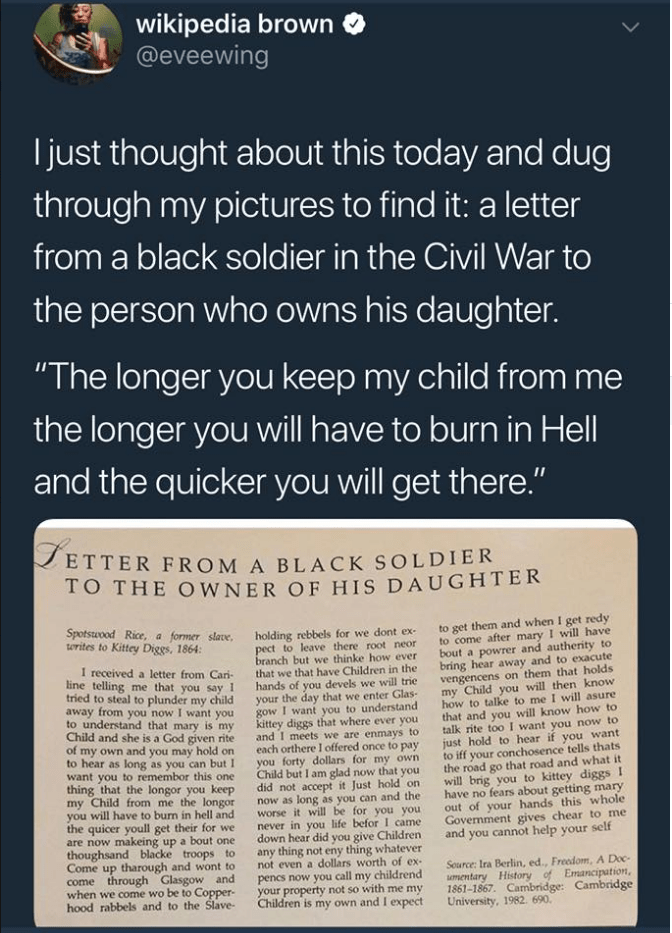
I just thought about this today and dug through my pictures to find it: a letter from a black soldier in the Civil War to the person who owns his daughter. “The longer you keep my child from me the longer you will have to burn in Hell and the quicker you will get there.“
photo text (with corrected spelling and broken into sentences, paragraphs):
Letter from a Black Soldier to the Owner of His Daughter
Spotswood Ric, a former slave, writes to Kittey Diggs, 1864:
I received a letter from Cariline telling me that you say I tried to steal, to plunder, my child away from you. Not I want you to understand that Mary is my Child and she is a God given rite of my own.
And you may hold on to her as long as you can. But I want you to remember this one thing, that the longer you keep my Child from me the longer you will have to burn in hell and the quicker you’ll get there.
For we are now making up about one thousand black troops to come up thorough, and want to come through, Glasgow. And when we come woe be to Copperhood rebels and to the Slaveholding rebels. For we don’t expect to leave them there. Root nor branch. But we think however that we (that have children in the hands of you devils), we will try your the day that we enter Glasgow.
I want you to understand Kittey Diggs that where ever you and I meet we are enemies to each other. I offered once to pay you forty dollars for my own Child but I am glad now that you did not accept it. Just hold on now as long as you can and the worse it will be for you.
You never in you life before I came down hear did you give children anything, not anything whatever, not even a dollars worth of expenses. Now you call my children your property. Not so with me.
My children is my own and I expect to get them. And when I get ready to come after Mary I will have both a power and authority to bring her away and to exact vengeances on them that holds my Child.
You will then know how to talk to me. I will assure that. And you will know how to talk right too. I want you now to just hold on; to hear if you want to. If your conscience tells that’s the road, go that road and what it will bring you to Kittey Diggs.
I have no fears about getting Mary out of your hands. This whole Government gives cheer to me and you cannot help yourself.
Source: Ira Berlin, ed. Freedom, A Documentary History of Emancipation, 1861-1867. Cambridge: Cambridge University, 1982, 690.
I wanted to find out what happened (DID HE GET HIS DAUGHTER BACK?) and the answer is that not only was he reunited with his family, but went on to be a successful minister and his daughter was interviewed in the 30s for the Slave Narratives Project.





 funeral-biscuit