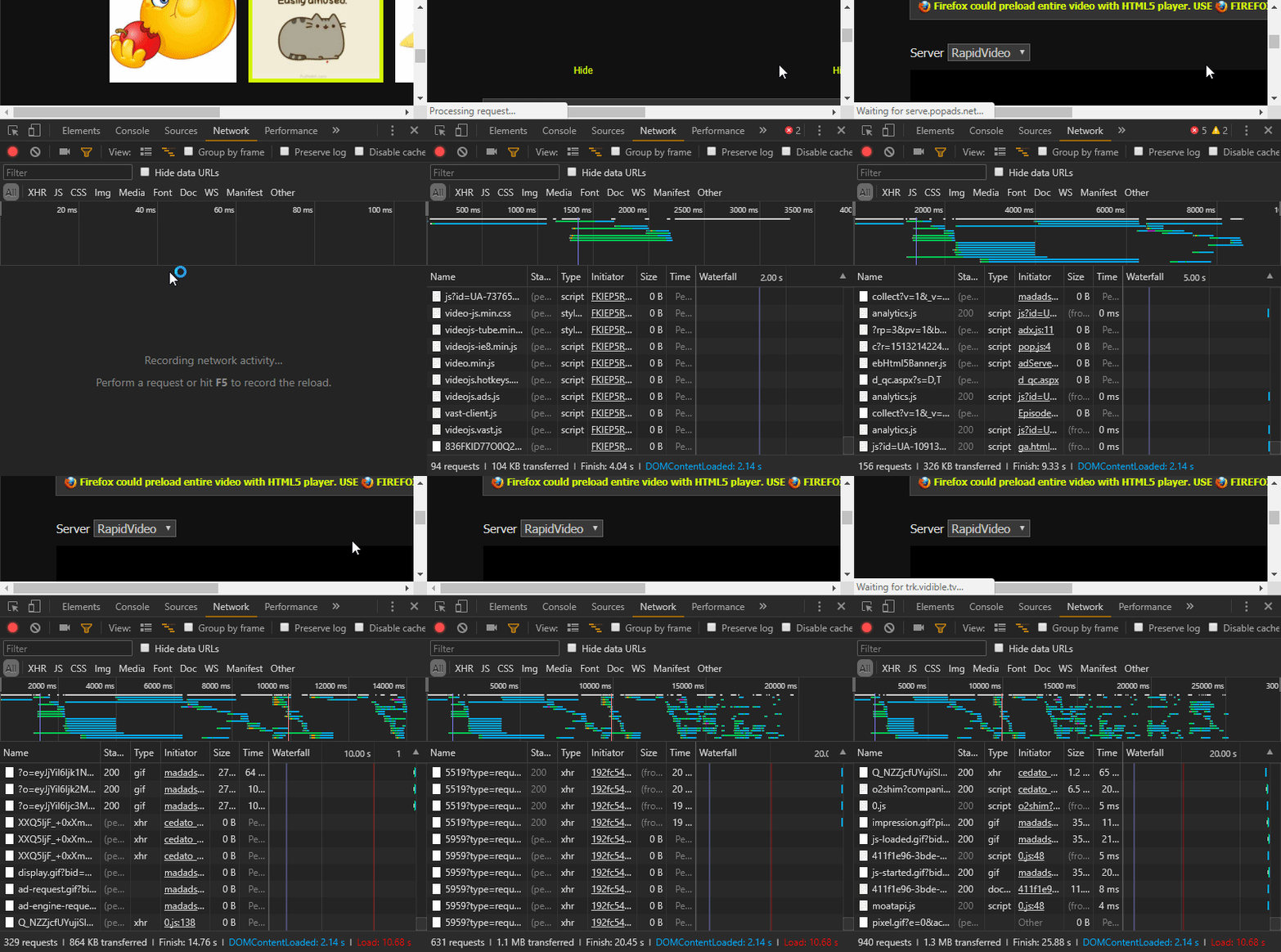
And that’s just like, one of the hundreds/thousands of other sketchy things the site has going on in the background by just sitting on any of its web pages without an adblocker/scriptblocker
Yo, if you wanna use KissAnime, you gotta be able to protect yourself & your computer from its shadiness. This post is discouraging, but sadly, there aren’t any less shady alternatives (aside from the legal streaming sites, of course) Anyway, if you wanna use any streaming site, you should download these Chrome extensions:
This extension is a lifesaver, seriously. Personally, I’ve never seen it used on Kiss, but it works a lot on other streaming sites. With uBlock, Essentials, and Pop Up Blocker, it’s very rare that I see ads.
As the name suggests, it blocks crypto miners. I can’t vouch for its reliability yet, as it hasn’t blocked anything for me atm.
I also use a tampermonkey script to block the “Are You Human?” thing. Pretty sure it’s on the Kissanime reddit (also, if you use Kiss a lot, browse that sub even more!! It’s really useful to know what the hell is going on the site before you risk your computer). Make sure to download Malwarebytes, too!
reblogging this again because this is a much better version than just saying “dont use kissanime”
All illegal streaming services do stuff like this, so instead of going somewhere else, learn how to protect yourself from malicious advertisements.
STRANGE WATERS is a queer fantasy comic anthology surrounding the theme of water. Water is a polarizing element that unites us all in one way other another. In STRANGE WATERS, you will find stories about daring feats of maritime exploration, overcoming despair, finding love in unexpected places, merfolk, pirates, and much more. The stories featured in STRANGE WATERS are all created by queer creators who identify at varying points of the queer spectrum, creating a book that’s as diverse as the ocean itself.
I was on the subway today, and when the train got delayed, this little kid was like, “fuck,” and a literal chorus of grown-ups went: “HEY.”
let him say fuck
I was at a crossing once and a kid’s dad said ‘and we have to wait for the green man’ and the 30 people on this crossing all stood waiting for the green man just to prove to this kid that that’s what you do. I’ve never seen anyone wait for the green man on this crossing before you just go when its clear. But Everyone Waited.
Every Adult In “Harry Potter” Let Us Down At Some Point And That’s Important a 900 page dissertation by me
And that includes Joanne Kathleen Rowling a tear stained afterword by me
Hagrid Is The Exception a rebuttal by me
The Time Hagrid Told Voldemort How to Take Out Something Protecting an Object that Grants Immortality When He Was Drunk and Other Well-Meaning Fuck Ups a lengthy chapter
You’re Absolutely Right a retraction
How dare you assume Molly Weasley has done anything wrong ever
That Time Molly Yelled At The Twins And Ron For Saving Harry From Abuse And Starvation, Thus Likely Communicating To The Abused Kid In Her Presence That His Welfare Was Less Important Than Not Borrowing The Car, That Time Molly Was Utterly Condescending About How Harry Is A Child And Doesn’t Deserve To Know Anything In A Way That Probably Heightened His Determination To Prove Otherwise, That Time Molly Said The Twins Put Together Aren’t As Good As Any Of Their Brothers Over OWL Results That They Worked Hard On And Were Proud Of, That Time Molly Forcibly Cut Her Adult Son’s Hair Right Before His Wedding, That Time Molly Spent A Year Being Mean And Rejectful Toward Her Son’s Fiancee, That Time Molly Sent Hermione A Deliberate “Fuck You” Present For Easter Because She Believed A False Story Written In Witch Weekly Without Making Any Attempt To Ask The People Actually Involved, Those Times She Made Her Youngest Son’s Christmas Sweaters His Least Favorite Color, And Every Time She Belittled Her Husband’s Hobby, The Twins’ Interests, And Bill’s Appearance Because She Couldn’t Be Bothered To Understand Or Value Or Even Be Kind About Thema detailed reminder that no one’s perfect and sometimes what one person doesn’t mind or see hits another person hard
Florean Fortescue Just Wanted To Sell Some Ice Cream And Help Harry With His Homework He Is The Only Adult Who Didn’t Mess Up Until Getting Killed By Voldemort, RIPan increasingly strident addendum by me
OK You’re Absolutely Right Florean Fortescue Was In Fact Perfect As Far As I’m Awarea concession by me
ok who gonna tell me how mcgonagall fucked up
and my dear child trelawney?
McGonagall let Dumbledore leave Harry on a doorstep even after a full day of watching the Dursleys In Action, and Trelawny told a thirteen-year-old that her soul was too drab and dusty to comprehend Divination.
In pop culture, slackers are portrayed as playing guitar, but learning to play any instrument requires a lot of commitment and attention, the opposite of what a slacker stands for.
*psst* It’s the fact that capitalism doesn’t value artistic ability if it can’t turn a profit. Capitalism sees all the amateur buskers and starving artists and assumes that, since they’re barely getting by, they must not be putting in enough effort.
This persists into copyright cases. Some fair use cases have a very obvious judgment against artists who aren’t making money off their art. “They must be a bad artist,” the cases imply. “Let people just steal their stuff who are better at making money off of it.” DID YOU WANT A COPYRIGHT CRASH COURSE? OF COURSE YOU DID. PULL UP A CHAIR.
So, for instance:
Cariou v. Prince,
714 F.3d 694 (2nd Cir. 2013): Richard Prince, Well-Known Big Deal Artist with Fancy Million-Dollar Homes, takes some photos taken by photographer Patrick Cariou and alters them, basically along these lines:
Original photo on left; Richard Prince edition on right.
Cariou sues based on copyright infringement. Prince defends based on fair use and eventually wins on the vast majority of the photographs. What alarms me most about the case is how careful the court is to portray Cariou as a failure as an artist, giving us a whole detailed paragraph about how little money Cariou made off his photographs:
Cariou’s publisher, PowerHouse Books, Inc., printed 7,000 copies of Yes Rasta, in a single printing. Like many, if not most, such works, the book enjoyed limited commercial success. The book is currently out of print. As of January 2010, PowerHouse had sold 5,791 copies, over sixty percent of which sold below the suggested retail price of sixty dollars. PowerHouse has paid Cariou, who holds the copyrights to the Yes Rasta photographs, just over $8,000 from sales of the book. Except for a handful of private sales to personal acquaintances, he has never sold or licensed the individual photographs.
That paragraph is IMMEDIATELY followed by this paragraph:
Prince is a well-known appropriation artist. The Tate Gallery has defined appropriation art as “the more or less direct taking over into a work of art a real object or even an existing work of art.” J.A. 446. Prince’s work, going back to the mid–1970s, has involved taking photographs and other images that others have produced and incorporating them into paintings and collages that he then presents, in a different context, as his own. He is a leading exponent of this genre and his work has been displayed in museums around the world, including New York’s Solomon R. Guggenheim Museum and Whitney Museum, San Francisco’s Museum of Modern Art, Rotterdam’s Museum Boijmans van Beuningen, and Basel’s Museum fur Gegenwartskunst. As Prince has described his work, he “completely tr[ies] to change [another artist’s work] into something that’s completely different.” Prince Dep. 338:4–8, Oct. 6, 2009.
These twin paragraphs occur toward the beginning of the opinion, and note how they immediately set the tone: Cariou could barely give his book away, had to depend on friends and family; Prince is displayed in museums. Which of these artists, the opinion implies, is the one we should be supporting with the law? Why, unsurprisingly, the one making money!
One of the fair use factors is the effect of the alleged infringement on the market for the original work. Here’s the court’s analysis of that factor:
Although certain of Prince’s artworks contain significant portions of certain of Cariou’s photographs, neither Prince nor the Canal Zone show usurped the market for those photographs. Prince’s audience is very different from Cariou’s, and there is no evidence that Prince’s work ever touched—much less usurped—either the primary or derivative market for Cariou’s work. There is nothing in the record to suggest that Cariou would ever develop or license secondary uses of his work in the vein of Prince’s artworks. Nor does anything in the record suggest that Prince’s artworks had any impact on the marketing of the photographs. Indeed, Cariou has not aggressively marketed his work, and has earned just over $8,000 in royalties from Yes Rasta since its publication. He has sold four prints from the book, and only to personal acquaintances.
How can Cariou complain about his work being stolen, when he’s barely sold it himself? The court basically thinks it’s insulting of Cariou to imagine that he could be fit for Prince to notice, considering the rarefied air Prince occupies:
Prince’s work appeals to an entirely different sort of collector than Cariou’s. Certain of the Canal Zone artworks have sold for two million or more dollars. The invitation list for a dinner that Gagosian hosted in conjunction with the opening of the Canal Zone show included a number of the wealthy and famous such as the musicians Jay–Z and Beyonce Knowles, artists Damien Hirst and Jeff Koons, professional football player Tom Brady, model Gisele Bundchen, Vanity Fair editor Graydon Carter, Vogue editor Anna Wintour, authors Jonathan Franzen and Candace Bushnell, and actors Robert DeNiro, Angelina Jolie, and Brad Pitt. Prince sold eight artworks for a total of $10,480,000, and exchanged seven others for works by painter Larry Rivers and by sculptor Richard Serra. Cariou on the other hand has not actively marketed his work or sold work for significant sums, and nothing in the record suggests that anyone will not now purchase Cariou’s work, or derivative non-transformative works (whether Cariou’s own or licensed by him) as a result of the market space that Prince’s work has taken up. This fair use factor therefore weighs in Prince’s favor.
Prince is selling his works for millions of dollars; Cariou is a capitalist failure; so Prince is entitled to what he wants to take.
This same judgment can be found in more cases, like Blanch v. Koons, 467 F.3d 244 (2nd Cir. 2006), where, again, Big Deal Artist Jeff Koons took a photograph by Blanch and incorporated it into his art:
Again, in the fair use analysis, in the fourth factor, the court included a judgey paragraph about Blanch’s failure to make much money off of her photograph:
Blanch acknowledges that she has not published or licensed “Silk Sandals” subsequent to its appearance in Allure, that she has never licensed any of her photographs for use in works of graphic or other visual art, that Koons’s use of her photograph did not cause any harm to her career or upset any plans she had for “Silk Sandals” or any other photograph, and that the value of “Silk Sandals” did not decrease as the result of Koons’s alleged infringement. In light of these admissions, it is plain that “Niagara” had no deleterious effect “upon the potential market for or value of the copyrighted work.” 17 U.S.C. § 107(4).9 The fourth fair-use factor greatly favors Koons.
Now, of course, this isn’t in every fair use case. Many fair use cases don’t contain this judgey language. But I feel it’s important to call out the ones that do, to notice when that capitalist bias is creeping into the analysis.
Truthfully, copyright law seems generally bewildered by people who create for reasons other than monetary reward. As you may have gleaned, I am fiercely protective of the right to create *without* seeking money if you don’t want to, of the right to create things *just for fun,* and of that creative impulse being just as valuable and important and wonderful as those creative impulses that request payment. I wish the law would be better at recognizing that you’re not a worse artist less deserving of copyright protection because you’re not a millionaire.
Of course, I wish the law in general would be somewhat better at recognizing you’re not less deserving of protection because you’re not a millionaire.
controversial topics should be stuff like “is cloning good” or “should we fuck aliens” and not whether people deserve to be poor or deserve healthcare
exactly. we should already be onto the star trek problems of whether or not it’s okay to beam our consciousness directly into a satellite, or spend sixteen hours a day inside a holographic simulation of Middle Earth.



 funeral-biscuit